
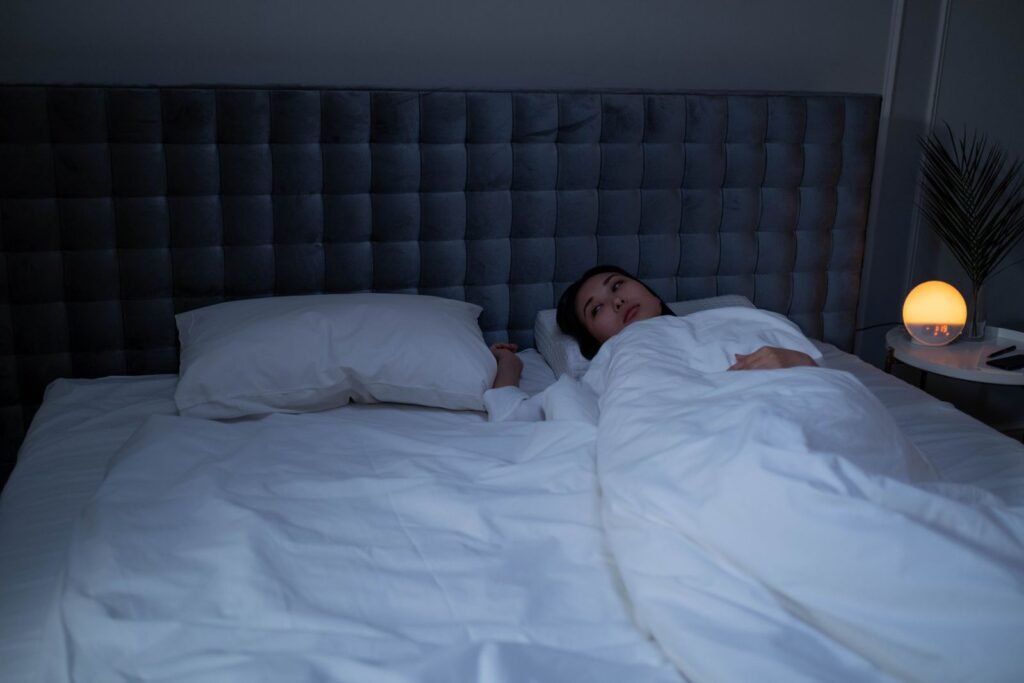
The clock says 3:14. Nothing woke you. No noise, no dream you can remember, no alarm. But your eyes are open, your heart is running a little faster than it should be, and a thought is already waiting — usually the exact one you spent all of Tuesday managing.
Waking up at 3 a.m. with anxiety is one of the most common complaints people bring to a first therapy appointment, and one of the least discussed in daylight. It feels like a personal defect, as if a well-organized mind would simply stay asleep. It isn’t. Some of what happens in the small hours is ordinary biology; some of it is a loop your nervous system has learned. Both are more workable than they feel at 3:14 in the morning.
Your brain at 3 a.m. is not the brain you had at noon
Sleep isn’t one flat state. You move through four to six cycles a night, each roughly 90 minutes, and their composition shifts as the hours pass. According to the Sleep Foundation’s medically reviewed overview of sleep stages, deep slow-wave sleep is front-loaded — most of it arrives in the first half of the night, and those stages shorten as you go. REM does the opposite: the first REM period may last only a few minutes, while later ones can run close to an hour.
So the 3 a.m. wake-up isn’t random. By then you’re surfacing from lighter, more dream-saturated territory rather than the deepest sleep of the night. Brief awakenings between cycles are normal — everyone has them. The difference between a good sleeper and a bad one often isn’t whether they wake, but whether they stay awake long enough to notice and form an opinion about it.
Why 3 a.m. anxiety feels worse than the same worry at 3 p.m.
Here’s the part that tends to bring real relief when people hear it: the brain region responsible for perspective is the one least available in the middle of the night.
Researchers at UC Berkeley scanned 18 young adults after a full night of sleep and again after a sleepless one. Their findings, published in Nature Human Behaviour in 2019, showed that without sleep the medial prefrontal cortex — which normally helps keep anxiety in check — went quiet, while deeper emotional centers ran hot. Anxiety rose by as much as 30%. “Without sleep, it’s almost as if the brain is too heavy on the emotional accelerator pedal, without enough brake,” said senior author Matthew Walker.
The team replicated the result, then tracked 280 people over four days: even small night-to-night changes in sleep predicted next-day anxiety. Participants who got more deep, slow-wave sleep woke with the lowest anxiety. Deep sleep, Walker suggested, functions as a natural anxiolytic.
Add the situational facts — no daylight, no one to call, nothing you can do about that email until nine — and 3 a.m. becomes a poor environment for evaluating your own life. The thought that arrives at that hour is rarely lying to you about what matters. It is almost always lying about the scale.
How the bed itself learns to keep you awake
Lying there wanting sleep and not getting it teaches your nervous system something.
That insight is the basis of stimulus control therapy, developed by psychologist Richard Bootzin in the 1970s and still among the best-supported behavioral treatments for insomnia. In the clinical protocol Bootzin co-wrote with Michael Perlis of the University of Pennsylvania, the mechanism is spelled out plainly: the bed and bedroom become cues for the distress and frustration of trying to fall asleep, and internal cues — mind racing, anticipatory anxiety, a body that won’t settle — become cues for further arousal.
Meanwhile the arithmetic starts. If I fall asleep right now I still get three hours and forty minutes. Nobody has ever fallen asleep faster because of that calculation.
The relationship runs in both directions, which is worth knowing before you spend energy deciding which came first. A systematic review in the journal SLEEP by Pasquale Alvaro and colleagues concluded that the best available evidence shows insomnia is bidirectionally related to anxiety and depression. Anxiety wrecks sleep; wrecked sleep manufactures anxiety. It’s a circle, not a chain, and you can enter it at either point.
What actually helps at 3 a.m.
The most effective instruction is the one nobody wants to follow: get out of bed.
Bootzin’s original rule: if you’re not asleep after ten or fifteen minutes, get up and go to another room. Perlis’s refinement is more usable — skip the timer, since clock-watching is its own form of arousal. Turn the clock face away, and get up when you notice you’re awake and frustrated. From there:
Stay up until you’re actually sleepy, usually at least fifteen minutes. The protocol suggests deciding in advance to stay up for thirty or sixty minutes rather than monitoring yourself for sleepiness, which tends to become one more performance to fail at.
Keep the lights low and stay off the laptop. Even ordinary room light can shift circadian timing, and a screen at arm’s length is brighter than most people realize. Reading by a dim lamp is fine. Email is not.
Don’t sleep on the couch. The point is to rebuild the association between your bed and sleep.
Go back to bed anyway, even at 4:45. If you have forty-five minutes or more until your usual wake time, it’s worth returning.
Get up at the same time every morning regardless — including Saturdays. This is the anchor everything else hangs on.
One honest caveat from the same protocol: it often feels worse before it gets better. Perlis warns patients they may be “up and down like a yoyo” for a few nights, sometimes a couple of weeks. That’s the treatment working, not failing. If your days feel flattened as well as your nights, it’s worth reading about the difference between burnout and depression. And during a heat wave, this isn’t your imagination — we’ve written separately about how extreme heat affects mental health.
When it’s more than a rough stretch
A few bad nights after a hard week are ordinary. Chronic insomnia has a threshold: symptoms at least three nights a week for at least three months, causing real distress or impairment. Roughly 6 to 10% of adults meet it.
If you’re in that territory, the guidance from the American College of Physicians is unusually direct: cognitive behavioral therapy for insomnia — CBT-I, which pairs stimulus control with sleep restriction and cognitive work — should be the first-line treatment for adults with chronic insomnia, ahead of medication. Sleep medications are approved for short-term use, ideally four to five weeks, and the ACP urges clinicians to look underneath the insomnia for treatable causes: depression, pain, substance use, sleep apnea, restless legs.
Anxiety deserves the same scrutiny. The National Institute of Mental Health estimates that about a third of U.S. adolescents and adults experience an anxiety disorder at some point — common, not minor. If the thought waiting at 3 a.m. is the same thought every night, that isn’t a sleep problem in disguise. It’s information about your waking life, and a therapist can help you do something with it. Here are some signs it’s worth talking to someone.
One thing should never wait until morning. If what surfaces in the middle of the night is hopelessness, or any thought of harming yourself, don’t lie there with it. In the US you can call or text 988, the Suicide & Crisis Lifeline, at any hour — including 3 a.m. That is exactly what it’s there for.
For most people, most nights, this is a smaller story than it feels like. The night isn’t handing you new information — it’s turning the volume up on information you already had, at the hour when you have the fewest tools to hear it clearly. Morning really does change the arithmetic.
This article is for general information only and isn’t a substitute for professional diagnosis, treatment, or advice. Persistent sleep problems are worth raising with a doctor or a licensed mental health professional, who can rule out underlying causes and help you find the right approach. If you’re in crisis or having thoughts of suicide or self-harm, call or text 988 (Suicide & Crisis Lifeline) in the US — free, confidential, 24/7.